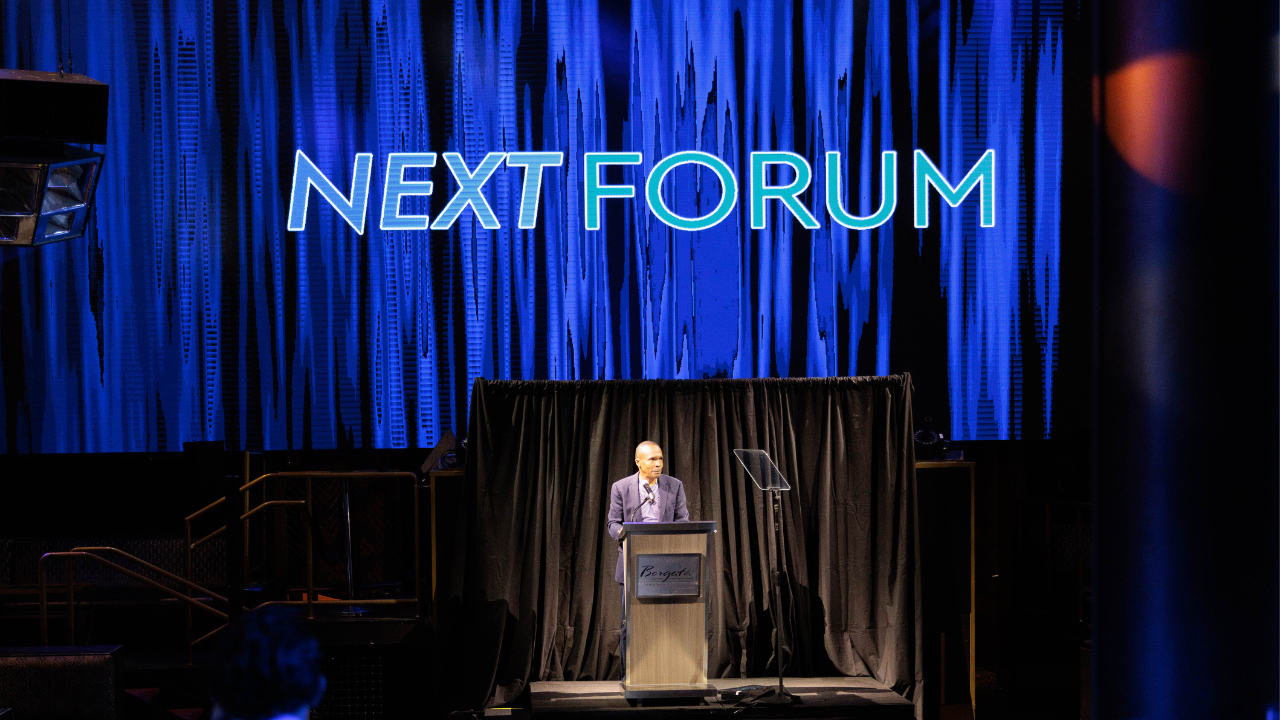
Bank Director’s Acquire or Be Acquired has long been known as the industry’s marquee M&A conference. But this year in Scottsdale, the conversation felt noticeably different. Technology, data, and differentiation dominated discussions just as much as dealmaking.
After visiting AOBA for the first time, Andrew Liesch, Head of Bank Strategy at Travillian, came away with a clear takeaway: banks are increasingly being forced to confront the same reality the market has been signaling for years. Technology is no longer optional, and the banks investing in it strategically are the ones positioning themselves to outperform.
In this Q&A, Travillian’s Chief Research Officer, Amber Buker, sits down with Andrew to unpack how AOBA revealed a clear shift in bank strategy and why technology is now central to how banks plan to compete in 2026.
From Deal Talk to Tech Talk at AOBA
Amber: Andrew, you just got back from Bank Director’s Acquire or Be Acquired Conference. For someone who had never attended before, what stood out to you most?
Andrew: The sheer volume of conversations. From the moment I arrived, it was nonstop catching up with people I’ve known for years and meeting new ones. With my background in sell-side research, I ran into bank management teams, investors, and investment bankers I worked with over nearly two decades. What surprised me most, though, was how much the conference felt like a technology event rather than a traditional M&A conference.
Amber: For people who haven’t been, what is AOBA usually known for, and how did this year feel different?
Andrew: I always assumed AOBA was primarily about buyers, sellers, and deal conversations. And those discussions were definitely happening. But what I wasn’t expecting was how dominant technology was in nearly every conversation I had. Almost everyone I met who I didn’t already know was connected to technology in some way. Even large tech firms were represented. I met leaders from companies that use artificial intelligence to improve small business lending, including Lama.ai, and others who provide solutions for Bitcoin-backed loan and deposit products, such as Galoy. It really felt less like an M&A-only conference and more like a “future of banking” conference.
Why Technology Dominated the Conversation
Amber: Why do you think technology took center stage this year?
Andrew: Because every bank is grappling with the same challenge: how to stay relevant while competing with institutions that spend billions annually on technology. Community and regional banks don’t have that kind of budget, so they’re being forced to think smarter about efficiency, customer experience, and employee productivity. Technology touches all of that. Whether it’s faster underwriting without sacrificing credit standards, fewer friction points in cash management, or better tools for frontline staff, the common theme was how to improve the client experience and keep what makes community banks special, all while having to compete against much larger institutions.
Differentiation, Scale, and the New Community Bank Playbook
Amber: You recently wrote about banks that outperformed in 2025 and pointed to differentiated stories as a key driver. Did the conversations at AOBA reflect that same idea?
Andrew: They did, though not always in the same way. Not every bank is going to be a fintech partner bank, like Coastal, Bancorp or FinWise, and that’s fine. What I heard more often were conversations about niche strategies and portability. Banks must ensure they have the technology platform that allows them to scale and execute on a niche strategy, especially if they pursue growth through acquisition. The questions banks need to answer are “Do we have the right technology to support a larger balance sheet?” And “What do we bring to an acquired franchise that will set us apart in the long run?”
Amber: That almost reframes what it means to be a community bank today.
Andrew: Exactly. Some banks are better off being the best institution in a smaller, stable market; that’s true scarcity value. Others want to expand into larger or faster-growing MSAs. If you’re going to do that, you need a clear strategy and something distinctive, and the technology to support that expansion.
How Banks Are Using Data to Compete More Intelligently
Amber: Data came up repeatedly in AOBA recaps and social posts. What did you hear on that front?
Andrew: Data was everywhere. The conversations really centered on three areas: deposits, credit quality, and lending. On the deposit side, banks want better insight into customer behavior around interest rate changes and propensity to move money. If you truly understand how sensitive your depositors are, you may be able to price deposits more advantageously relative to the market. That can meaningfully improve margins over time.
Amber: And credit quality?
Andrew: That’s where data becomes even more powerful. Banks are trying to identify stress before it shows up in financials. If you can see early indicators in specific industries or geographies, you can work with borrowers months ahead of potential problems. That proactive approach can make a real difference in outcomes.
Amber: What about lending?
Andrew: This is where banks can become more consultative. Data can help bankers identify growth opportunities their clients might not see themselves. That solidifies the relationship as advisory rather than transactional. When both the client and the bank win, that’s a powerful dynamic and one the market tends to reward over time.
M&A Strategy Versus Market Reality
Amber: AOBA is still an M&A conference at its core. How did deal discussions line up with what the stock market is rewarding right now?
Andrew: There’s no shortage of deal momentum. A lot of it is pent-up demand from the last few years, especially prospective sellers looking for an exit. Strategically, many deals make sense long term, especially when a bank is acquiring a franchise that can’t be replicated. That shift toward preparation, diligence, and long-term fit is reshaping how banks think about M&A well before a transaction is announced. But from a stock performance standpoint, buyers are still being penalized in the near term. The market has been pretty clear about that. Integration risk, tangible book dilution, and earn-back timelines continue to weigh on stock performance.
Amber: So how should bank leaders reconcile that?
Andrew: If the strategic rationale is sound and improves the long-term franchise, deals can absolutely create value. But leadership teams need to be realistic about short-term market reaction. The market isn’t wrong, but it is impatient. That’s something boards and executives need to factor into their decision-making.
Why AOBA Signals Where Bank Strategy Is Headed
Amber: Final question. Do you think AOBA’s tech-forward focus is a reflection of banks finally catching up to what the market has already been telling them?
Andrew: I do. The right technology is becoming table stakes. It affects customer experience, employee satisfaction, and long-term competitiveness. I expect even more focus on technology investment going forward, and I’m genuinely excited to see how those conversations evolve next year.