What Drives Premium Valuations Among Top U.S. Banks
Welcome back to Bank Land and the second piece in our series examining bank stocks. The first part covered the best-performing bank stocks in 2025 (check it out HERE), and today, we are investigating the characteristics of the most highly valued banks in the industry and what sets them apart from peers.
Our universe consists of all 212 major exchange-traded banks with assets between $2 billion and $40 billion. We intentionally expanded the scope from our first piece to better capture the diverse drivers behind premium valuation multiples. In our universe, the average bank is trading at 139% of TBV, and there are 23 banks in the table below trading at two standard deviations exceeding that level.
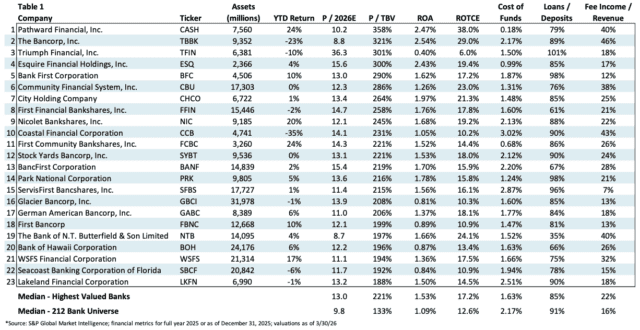
I had long assumed that well-above-average profitability would correspond with the highest valuations and, for many of these banks, that holds true. The median ROA of 1.53% among our top 23 institutions materially exceeds the 1.09% median for the full universe, and we observe a similar pattern in ROTCE. However, the paths banks take to achieve this level of profitability varies across the group.
Core Deposits are A Building Block to Top-Tier Profitability
Ask almost any bank investor and they will say that the true value of an institution lies in its deposit base. This is hardly a novel observation: a low-cost, tenured, and loyal deposit franchise provides an excellent foundation for building a highly valued bank. Consistent with that view, the vast majority of institutions in our sample maintain funding costs below the universe median. Only four exceed the median cost of funds of 2.18%, and just three others are above 2.00%, leaving most of the highly valued banks with enviably low funding costs.
Such franchises are rarely built overnight. In many cases, they have been cultivated over decades — more than a century for some, including City Holding, Bank of Hawaii, and Stock Yards — as these institutions developed deep community ties and consistently met the needs of their depositors. However, as our analysis shows, an outstanding deposit franchise is not strictly necessary to achieve a premium valuation.
Flight to Quality is Real
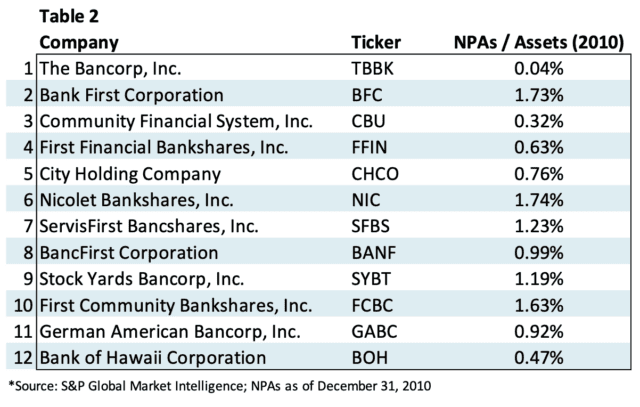
In the aftermath of the financial crisis, banks that avoided the severe credit problems that afflicted much of the industry emerged with well-deserved valuation premiums. Since 2007, 12 of the 23 banks in Table 1 have never reported NPAs exceeding 2.00% of assets. Investors have taken note, continuing to reward these institutions with elevated trading multiples as this sustained credit outperformance remains firmly embedded in market perception.
During subsequent periods of credit stress, when the broader sector often sells off sharply, banks with long track records of superior asset quality tend to decline less and recover more quickly. Investors frequently gravitate toward these names as relative safe havens, reflecting confidence in their resilience and underwriting discipline.
A Niche Focus Differentiates the Storytelling
While many of these institutions benefit from long-tenured, low-cost deposit bases and exceptional credit quality track records, a meaningful number of highly valued banks do not. Instead, they differentiate themselves in other ways, often by focusing on specific niches where they can achieve superior growth, pricing power, or returns.
Three banks on this list — Pathward, Bancorp, and Coastal — provide banking-as-a-service (BaaS) solutions to fintech partners. For these first two, this model produces some of the strongest profitability metrics in the industry. Although Coastal’s ROA and ROTCE currently trail those peers, its outlook is compelling: analysts project these measures could approach approximately 2.00% and 20.0%, respectively, by late next year.
Coastal also benefits from a high profile as a leading BaaS partner to fintechs, which enhances its investment narrative, particularly given its pipeline of prospective relationships. These platform-driven partnerships provide differentiated growth avenues compared with more traditional banking models.
Importantly, simply offering BaaS services is not a guarantee of a premium valuation. Utah-based FinWise (FINW) also partners with fintechs and generates an ROA near 2.00% and ROTCE of roughly 10% (even more notable given its elevated TCE ratio of 19.5%). Despite these strengths, the shares trade at only about 115% of tangible book value. Admittedly, with less than $1 billion in assets, FinWise operates outside the typical institutional investor universe that follows larger BaaS platforms. Still, it represents a compelling case study to watch in the coming years. If management executes on its strategy and scales the franchise, the current valuation gap could narrow meaningfully.
Beyond the BaaS-focused banks, several other institutions on the list derive their appeal from distinct niches that create scarcity value and differentiated investment stories. Esquire, Triumph, and Butterfield each exemplify this dynamic in different ways. Esquire combines a niche focus on the legal industry with a nationwide tech-forward payment processing vertical. Triumph serves the trucking industry through invoice factoring and payments solutions delivered at scale across the country. And Butterfield dominates its home market of Bermuda from a local community banking standpoint, which helps warrant premium pricing and aids in competing against much larger brethren.
Esquire and Butterfield leverage their niche advantages to produce outstanding profitability. Triumph, by contrast, stands out because its ROA and ROTCE trail every other bank in Table 1. On current metrics alone, the valuation premium for Triumph Financial shares is difficult to justify. However, investors are clearly attracted to the company’s strong market position, growth runway, and the potential for returns to expand materially over time.
M&A Not a Headwind for These Banks
Another notable takeaway is how active many of these institutions have been on the acquisition front. Eleven of the banks in Table 1 announced at least one transaction in the past three years, yet still command elevated valuations.
In January, Travillian reviewed stock performance following all bank acquisitions announced in the second half of last year, and the results were broadly discouraging, as acquirers significantly underperformed the industry. The market’s message has been clear: announcing a deal often places the acquirer’s stock in the penalty box. But what makes these 11 banks unique is their apparent immunity to that dynamic. Investors have largely granted them the benefit of the doubt — a reflection of their long track records of superior returns and disciplined value creation.
Two recent transactions illustrate this point. Nicolet’s acquisition of MidWestOne, announced last October, put its currency to work in a deal management believes will enhance the franchise and improve already above-average profitability. CEO Mike Daniels emphasized that he evaluated the transaction “through the lens of the shareholder,” expecting “top-quartile, if not decile, results.” The stock initially sold off (which shouldn’t have been surprising) but has since recovered and continues to trade at a premium valuation.
Esquire’s announced acquisition of Signature Bancorporation a few weeks ago produced the opposite response, with shares rising approximately 7% on the announcement day. The deal provides entry into the Chicago commercial banking market and adds exposure to one of the largest legal markets in the country, where Esquire previously had limited presence. The positive reaction reflects both the strategic logic of the transaction and the credibility the company has built with investors over time, which further supports the stock’s robust stock valuation.
Not Just High Valuations, but Also Strong Returns
Four institutions in this analysis — Bancorp, Butterfield, Coastal, and Esquire — also appeared in Part One of this series as top stock performers in 2025. Collectively, these banks appeal to investors seeking differentiation. Replicating a century-old deposit base with deeply embedded, low-cost funding is nearly impossible for most institutions. By contrast, building a distinctive business model and articulating that story effectively can deliver comparable valuation outcomes and, in some cases, superior stock performance.