Like many community bank CEOs, Doug Fish gets a lot of windshield time as he drives from one of his bank locations to the next. I can imagine the farmland rolling by as he navigates the winding, two-lane road going south from Missouri to Arkansas during a recent phone interview. Fish’s home state has some of the most fertile land in the nation, with rich topsoil that formed as ancient glaciers receded.
Fish has been the President and CEO of BTC Bank for over thirteen years, but he’s known the bank for most of his life. He remembers visiting the Bethany, Missouri-based institution as a child tagging along with his dad who was a local farmer. For his part, Fish keeps a small farm and a few head of cattle still today, primarily as a form of ‘stress relief’. A love for agriculture seems to run through Fish’s veins, and it’s baked into the DNA of the bank he leads today. That background gives the executive both a reverence for the sector, and a clear-eyed approach to his optimism for it.
Today, agricultural lending is growing in dollars but shrinking in opportunity. While loan balances are rising due to inflation and carryover debt, the pool of healthy borrowers is tightening — and so is the universe of acquisition targets. Banks heavily concentrated in struggling agricultural portfolios can make less attractive acquisition candidates, creating a more selective and risk-sensitive M&A environment.
The Intertwined Nature of Banking and Agriculture
In a January interview, I kept Fish company as he made the seven-hour drive from BTC headquarters to the bank’s newest loan production office just over the border in Arkansas.
He pointed to the parallels between banking and farming explaining, “the consolidation in our industry is also happening in others, like agriculture. You’ve got farmers, ranchers where succession for their operations — it doesn’t exist. So instead of it continuing as it has for the 50 years of their productive life, it gets sold to a neighbor, and you have one less. That’s kind of like what’s happening in banking,” he continued, “where an institution like The Tipton Latham Bank [which BTC announced it was acquiring in December 2025] will become a branch of BTC, and you’ll have one less. Same thing.”
With this framing, the intimate connection that has always existed between banks and farms is placed front and center.
The number of banks in the U.S. peaked at over 30,000 around 1922. Many of the institutions that popped up were single-office operations, often formed with a few thousand dollars of capital specifically to finance local farms. When crop prices collapsed after World War I, farm foreclosures rose drastically and thousands of banks failed alongside them. The system didn’t stabilize again until the creation of the FDIC in 1933.
When crop prices take a beating and costs keep rising — as they have in recent years — both banks and their farm clients start to worry.
New Sector Highs and Top Performers
In September, S&P reported that U.S. lenders finished the second quarter of 2025 with $205.38 billion in agricultural loans, surpassing the $205.20 billion recorded at the end of 2024, which had been the highest in over a decade. That level of loan growth is more a sign of stress in the market than prosperity. Farmers are borrowing to cover rising costs, manage carryover debt, and absorb their shrinking margins.
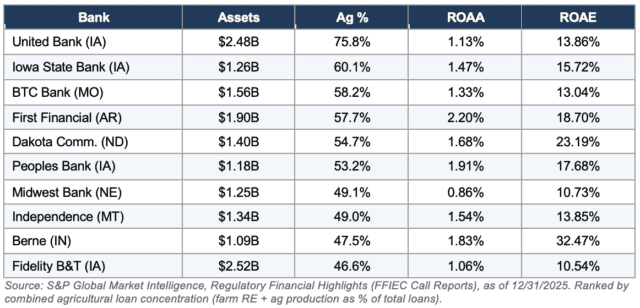
To understand how this is playing out for the banks that service the industry, we analyzed regulatory financial data for the ten most ag-concentrated U.S. banks with $1 billion to $30 billion in assets, using S&P data. What we found is a sector climbing back from the earnings trough caused by the 2023 rate-hiking cycle — but running hard against constraints that could reshape the competitive landscape.
Earnings Recovery is Real, But Uneven
All 10 of the top-performing ag banks posted improved ROAA in 2025, as legacy low-yielding assets added in 2021-2022 repriced higher. Some of the top ag lenders have now exceeded their pre-hike profitability (like First Financial Bank in Arkansas (2.20% ROAA) and Peoples Bank in Iowa (1.91%)) or substantially recovered toward their pre-hike levels.
Banks that entered the rising rate cycle with strong core deposit franchises and variable rate exposure came out ahead, but others are still catching up. Several of the top 10 ag banks have only recovered to pre-2021 levels after dramatic drops in ROAA and total equity. For these banks — with the thinnest margins — the headwinds in agriculture don’t bode well for their recovering performance.
The 2025 survey of ag lenders from the ABA and Farmer Mac revealed that less than 50% of ag borrowers are expected to be profitable in 2026 — the lowest level since 2020. In addition, nearly 93% of lenders expect farm debt to increase over the next year, reflecting tighter working capital and increased reliance on credit. Continued improvement in returns depends on borrowers being able to service their loans. If half of them really do become unprofitable, the recovery may not hold.
A Sector Running Out of Deposits
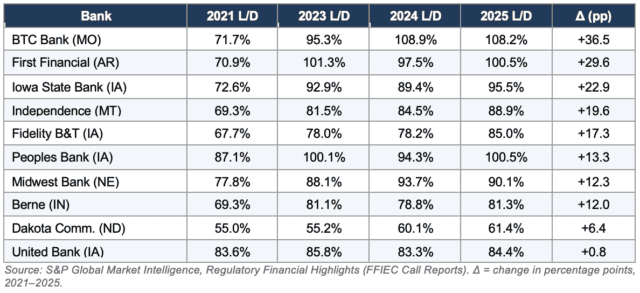
The most striking pattern across all ten top performers was the relentless rise in loan-to-deposit (L/D) ratios. Every bank in the group saw L/D rise over the 5-year period from 2021–2025. Several banks saw increases of 12 to 20 percentage points, while three — BTC Bank, First Financial, and Iowa State — experienced surges of more than 20 points. United Bank of Iowa was the lone exception, barely moving from 83.6% to 84.4%. Dakota Community Bank also remained relatively stable, rising just 6.4 percentage points over the period.
The driver behind the L/D ratios was aggressive loan growth. The fastest-growing ag lenders saw their loan portfolios expand 55% to 78% over the period, reflecting a mismatch between surging credit demand and the bank’s ability to attract proportional core deposit growth in their rural markets.
Meanwhile, brokered deposits and jumbo time funding have increased at multiple institutions. These are banks reaching beyond their core deposit franchises to meet loan demand that’s being driven by stress in the sector, not growth.
Early Signs of Pressure
Credit quality among the top ag banks remains broadly clean — seven of ten banks carry nonperforming assets below 0.55%. While we can’t attribute NPAs specifically to ag-related loans, there are a few items to watch.
First Financial carries some chronic NPAs at 2.48% of assets, and Bank of Berne’s NPAs have slowly crept up each year since 2021. Most notable, though, is the development at Peoples Bank where NPAs surged from 0.02% in 2023 to 0.55% in 2025, with noncurrent loans jumping to 1.11% of total loans. Peoples carries the highest production lending concentration in the group — 38.4% of loans in crop and livestock operating lines. If those deteriorating credits sit in the production book, it could be an early signal of stress in the segment most exposed to commodity prices and carryover debt.
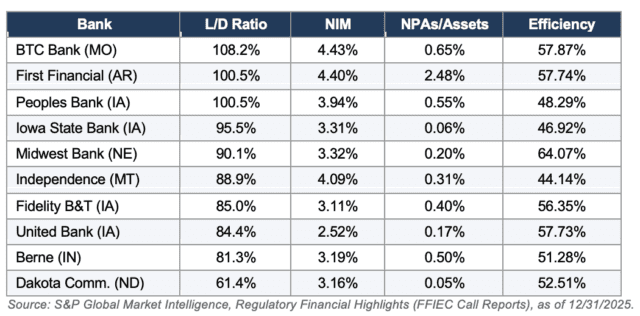
To be clear, the data does not suggest systemic distress across ag banks. Reserve levels remain strong across most institutions, and several diversified ag banks continue to post healthy returns. Instead, it reveals a widening performance gap between institutions with disciplined underwriting and those more exposed to commodity volatility.
“A lot of our farmers had a really tough 2025,” explained Greg Steffens, Chairman and CEO of another Show-Me State institution — Southern Missouri Bancorp. “It’s somewhat crop dependent on what you’re growing. If you’re growing corn and soybeans in our area now, you’re breaking even. If you raised cotton or rice, which is big in these areas, you didn’t do well at all.”
Steffens takes a cautious approach to ag lending. Like Fish, Steffens is a bank CEO with agriculture in his upbringing. He grew up on a farm that produced some of the same row crops that are struggling today. He also raises about 2,500 hogs every six months. With ag loans comprising about 11% of Southern Missouri’s loan book, Steffens has a meaningful stake in the sector. But he keeps a discerning eye on the portfolio. His observations reinforce the trend alluded to in the ABA’s survey data: he estimates that 30–35% of Southern’s agricultural borrowers weren’t able to meet their total obligations last year.
Southern Missouri is a highly acquisitive bank, doing a deal every one to three years since 2014. When asked whether there were still enough ag banks out there that might make a good target, Steffens didn’t mince words.
We’re not scared of ag … but farmers have had two tough years in a row and, right now, if you’re penciling out activity for ’26, it’s not going to be a good year unless something happens with prices. So if we’re looking at anything ag-related from an M&A standpoint, we’re going to give it twice the looking over.
What It Takes to Grow in Ag Lending Today
One of the enduring truisms about community banks is that their relationships and local knowledge are what makes them unique. Perhaps nowhere is that sentiment more powerfully applied than in ag banking. Banking ag looks very different depending on where you are. Are most producers in your market growing row crops or raising livestock? Do the operators own the land, or are they mostly tenant farmers and contract growers? The risk profiles vary significantly in the sector, even in different parts of the same state.
“If we’re looking at an ag bank right now, we’re really scrutinizing the ag portfolio with a lot of detail,” Steffens says. “What we historically have found is the smaller the bank, the poorer their controls and underwriting.” Steffens notes that smaller institutions tend to roll over borrowers year after year without going deep on the fundamentals.
What’s more, the ag banks that remain are often too small to move the needle. “We have bought some banks that were fairly concentrated in ag,” Steffens says. “But at this point, for us to look at a deal, they need to be roughly $500 million in assets. A $125 million-dollar ag bank doesn’t do enough for us.” Those banks may need to find a partner among their ilk — a difficult proposition in a shrinking universe.
How BTC Bank Is Betting Big on Agriculture
At BTC Bank, Doug Fish sees the same headwinds but draws a different conclusion. BTC is the fastest-growing bank in the top 10 data set — with 72% asset growth over five years, a 108% loan-to-deposit ratio, and a portfolio that is heavily concentrated in ag.
Fish acknowledges the stress in row crops, offering “carryover is a four-letter word in our world.” But his confidence rests on diversification within agriculture — poultry, cattle, and row crops in roughly equal measure — backstopped by government programs and crop insurance that didn’t exist in earlier downturns.
In December, BTC announced its acquisition of The Tipton Latham Bank, which Fish describes as a good cultural match. He’s crafting deals with small-town institutions where the only thing that changes is the name on the sign. “We’re looking for a community; an organization that fits what we are,” he said.
It seems that BTC isn’t having trouble finding banks with the desired profile. Fish has already identified another good cultural fit in a deal that will be announced to broader press in the coming days. This week, BTC agreed to acquire Tri-County Trust Company, located in Glasgow, Missouri. At the end of 2025, S&P listed Tri-County’s total assets at $61.5 million, while Fish puts the figure at $63 million based on the most recent financials. The single-branch bank is just 15 miles from two other communities that BTC already serves. And with that new addition, Fish’s growth engine keeps churning.
Asked about banks pulling back from ag, he was direct about his perspective. “I’ve seen it much, much worse than it is. You can look at our numbers and you would agree — we’re betting the bank on agriculture, literally. The communities we’re in are driven by agriculture. And for the banks out there that are concerned about it — if you want to send me your customers, we’ll try to take care of them for you.”
Where the Sector is Headed
Both CEOs agree on one structural challenge that may matter more than commodity prices: the ag lending talent pipeline is drying up.
Fish traces the gap to the 2008 financial crisis, which drove a generation of early-career lenders out of the industry. The result is a void in the mid-40s to late-50s age cohort — exactly the experience level that makes someone a chief credit officer or the person who structures a seven-figure operating line. Steffens puts it simply:
There’s a shortage of ag-related lenders out there.
The ABA survey data confirms the broader trend: more than 75% of surveyed ag lenders expect farm retirements to accelerate in the next 12 months. When the farmer retires and the lender who knew him retires, the relationship that held the loan together disappears.
A century ago, the farm economy’s collapse took half of America’s banks with it. Today’s tools are better — deposit insurance, crop insurance, a Farm Credit System. In December 2025, the USDA announced a $12 billion Farmer Bridge Assistance program — with $11 billion in direct payments to row crop producers — to help address market disruptions, elevated input costs, and trade losses. The bridge payments are scheduled to arrive this month, and loan officers will use them to underwrite 2026 operating lines that might otherwise have been impossible to structure. But the payments are designed, by their own name, as a bridge — to stepped-up safety net provisions that don’t take effect until October. And the improved bank earnings that look like recovery are built on loan portfolios repriced at rates that many borrowers may not be able to sustain. A lot can happen between now and harvest.
The ten banks in this analysis carry a combined $16 billion in assets and agricultural concentrations ranging from 47% to 76% of their loan books. The strongest franchises are built to weather commodity volatility and tightening liquidity. The question is whether the rest of the sector can say the same.