When an earthquake occurs in the deep ocean, people on dry land may not know it for several hours. There are special buoys in the water called DARTs — Deep-ocean Assessment and Reporting of Tsunamis — that measure the strength of the quake and help scientists predict the size of the wave that will follow. While officials model the size of the tsunami, a sign of what’s to come shows up on land. The shoreline dramatically recedes — revealing the ocean floor and reefs that are usually under water. Then the sounds start. You can hear something like a massive jet engine on the horizon just before the air raid sirens blare. By that point, you’d better be on high ground.
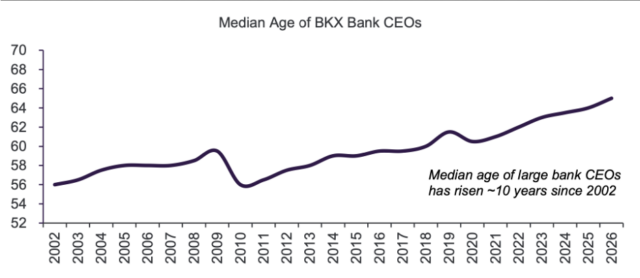
This summer, a type of DART buoy that the banking industry has always used to detect coming change started to pick up a signal. Truist Securities reported that, for banks in the BKX index, median CEO age has increased by 10 years since the early 2000s. After jumping more than 20% in the last two-and-a-half decades, half of BKX bank CEOs are now over the age of 65.
The Truist research report, authored by Senior Analyst John McDonald, found that while bank CEOs tend to be older than executives in other industries, this isn’t totally unique to our sector. CEO age is ticking up across all industries. Small business owners are increasingly selling their businesses to private equity firms rather than passing them down to their children. People are living and working longer.
But in banking, we’ve long looked to CEO age (plus change-in-control multiples) as a portent for potential M&A. And, at Travillian — a national executive search and talent strategy firm — we see the tide of up-and-coming executives starting to recede. So we dug into the numbers to uncover whether the correlation between CEO age and M&A is as strong as we think, and what this signal means for succession planning.
Is There a Retirement Tsunami on the Horizon?
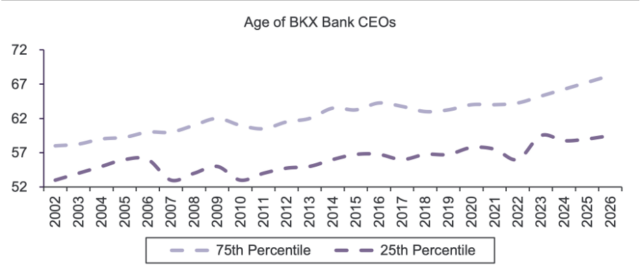
Median bank CEO age reaching 65 is an attention-grabbing stat that wouldn’t necessarily signal a wave of coming retirements on its own. But in combination with other factors, that does seem to be where we’re headed. The exhibits below come from the Truist Securities report McDonald published on June 8, 2026. They indicate that CEO age has gone up and so have the top and bottom quartiles.
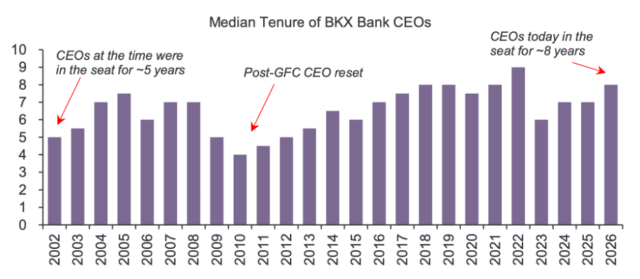
The Truist report also cited CristKolder Associates data showing the average tenure for CEOs in the financial sector is about 9 years (a tenure length surpassed only by CEOs in the technology sector). While bank CEO tenure has ebbed and flowed in recent decades, the tenure of the current cohort is reaching a peak.
“No one has a crystal ball,” McDonald says, “but it seems reasonable to us that we could see a step-up in CEO retirements just based on the fact that the current age of the executives in the industry has been rising. At the least, we might hope that we see some more turnover start to occur.”
McDonald explained that his team views retirements as healthy, natural processes to see play out, especially when a bank has underperformed. As he put it, “Regular turnover among the executive ranks is one way to ensure the company appropriately considers outsider perspectives, keeps the culture and strategy fresh, and cultivates the next generation of leaders at all rungs of the ladder.”
Who Earns the Right to Stay?
There is nothing magical about the age of 65. Just because an executive has reached that benchmark doesn’t mean they need to immediately think about exiting the stage. And boards should be assessing their CEO’s performance continuously well before that. The trouble is that many boards don’t seem to take a hard look until it’s very late in the game.
There are certainly benefits to having a long-tenured CEO. As the Truist report lays out, a long tenure can support consistent strategy over multiple cycles and cultural cohesion. It helps to establish the bank’s status as a “known quantity” on the Street.
But the benefits can be outweighed by the potential consequences. Consistent strategies can become stale. Complacency can set in among executives, while the board becomes too friendly with the top exec. And a CEO that keeps staying for “just a few more years” can drive younger talent to seek growth elsewhere.
Long-tenured CEOs don’t produce an obvious bump in performance either. The Truist report found little-to-no correlation between how long a CEO’s been in the seat and relative stock performance. If anything, that performance tends to be slightly negative.
This cuts against the idea that experience compounds. In the research report, McDonald posed the question — who earns the right to be a ‘legend’? In a subsequent phone interview, he explained, “There are a number of current and past CEOs in the financial services space that have earned ‘legend’ status due to strong long-term shareholder returns or financial performance, but this seems to be the exception and not the rule.” According to McDonald, “the main investor gripe is that CEOs too often confuse where they land on this ‘legend’ spectrum … and there is a lack of accountability when CEOs have stayed for a while without that track record of strong performance. There is no ‘divine right’ to be a bank CEO.”
What It Means for M&A
One of the most counter-intuitive findings of the Truist report was that CEO age is not the bellwether for M&A that industry commentators hold it up to be.
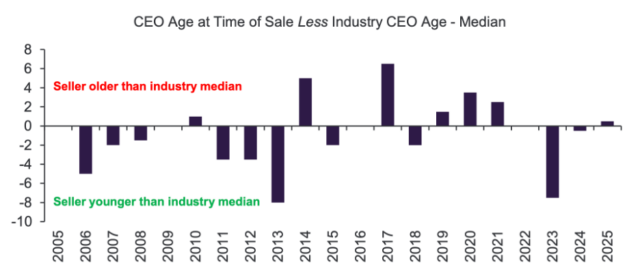
Truist found that, while the average age of a selling CEO has risen over time — with the average age of a selling CEO at 63 in the years from 2016-2025, up from 57 in the decade prior — that’s not the whole story. Selling CEOs were not sustainably older than the industry. In the Truist dataset, selling CEOs were actually younger than the industry median about half the time.
This doesn’t mean CEO age and tenure don’t impact decisions in the board room. Industry advisors have noticed succession concerns taking on more significance as banks wrestle with the future and what it takes to remain independent.
Steve Roth, Head of the Financial Institutions Group for Performance Trust Capital Partners, has noticed succession concerns adding pressure to M&A considerations. “We are seeing this become more and more of a conversation in boardrooms,” he said, noting that these are conversations boards should be having all the time, rather than waiting until the tide goes out.
Roth says a bank’s ownership structure can make the conversation more complex, especially in family-held institutions. “The ownership structure of the institution plays a key role when you start looking at the second, third, even fourth generation … Ownership concentration plays a huge role as well for a lot of the privately held institutions where we see this conversation popping up quite a bit. It’s an important one for banks to get out in front of.”
Roth is clear that there are many other factors that contribute to a decision to sell. The one that he and other industry advisors point to most is whether an institution has the ability to scale.
“Scale is the underlying tectonic factor driving M&A,” says Christopher Olsen, Managing Partner of Olsen Palmer LLC, an independent investment banking firm that specializes in M&A. “As the banking landscape grows more complex, there are strategic, technological, competitive, and regulatory reasons why scale is essential,” he says, but, “while every deal is driven — at least to some extent — by scale, a lot of decisions to sell are also driven by succession.”
Like Roth, Olsen sees succession as an issue that touches more than the top office. He shared how one recent transaction unfolded, saying that CEO retirement was driving sale discussions to some extent, but it wasn’t until the CEO’s number two — a Chief Operating Officer — announced their retirement that the decision to sell came into focus. “[The COO] had been at the bank for 50 years and literally ran the bank — the ins and outs, hiring, tech contracts, vendors. They knew everything and were just about irreplaceable. And so when they got to the retirement age, the bank and the board decided to sell.” Olsen reiterated that scale is the fundamental reason a bank usually decides to sell. But, ultimately, he says, “succession is absolutely a big driving force. Succession and shareholder liquidity, one or both of those will commonly catalyze a bank to pursue a sale.”
Where Banks Go From Here
Whether a bank is open to a sale or fighting to stay independent, succession planning matters. Olsen commented that, in the past, a bank’s management team would have likely been considered redundant when it comes to an M&A deal. But he’s seen that trend shift over the last decade or two. “A lot of times now, a buyer will say, look, I’m buying this quality franchise and a key to keeping it together, or a risk mitigation, is keeping management at least for a period of time,” Olsen explained. “Buyers are looking for management strength, and if they are not seeing that — either at the very top or maybe, if the CEO is retiring, right behind him or her — they may not be interested. It’s not a pricing thing. It’s a binary.” Especially when a buyer is going into a new market, Olsen says, the price on a deal can’t be low enough to entice a buyer if the acquirer doesn’t have a deep enough bench to transfer in.
Developing a bench is easier said than done. As Olsen observed, backfilling roles is a challenge that can be attributed primarily to two factors. “10, 20, 30 years ago, a lot of regional and national banks had trainee programs where younger, mid-level bankers would go through management training. Most of those have been done away with,” Olsen says, “and so there’s just not a training ground anymore to hire C level folks at banks from.” Compounding the dearth of talent is a more qualitative factor. Olsen has noticed that, “unfortunately, I’m not sure that being a banker is as alluring professionally to folks as it might have been several decades ago.”
Roth seems to agree, commenting that “recruiting next generation talent is a key challenge for financial institutions. We’re not technology or healthcare or some of the flashier industries that are attracting a lot of young, talented professionals.” To combat this, Roth says, “banks must have a very intentional development and mentorship philosophy in how they run their organizations.”
According to Roth, successful institutions need to start by identifying potential talent in the ranks. “That doesn’t mean you make a decision then and there, guaranteeing that that person is going to be in your C suite,” he cautions. This phase should consist of identifying the traits your bank wants in a leader and a particular candidate’s cultural fit. “Then,” he advised, “be very deliberate about how you start to develop that individual.”
Roth points to an exemplary institution he’s worked with that slowly incorporates young leaders into roles on the Investment Committee, ALCO, or credit review. They make sure the individual gets exposure to many areas of the institution. “Making it a very deliberate, intentional part of your human capital development, I think, is what separates institutions. Really developing your bench strength is the hallmark of a wise management team.”
For banks whose desire to remain independent runs deeper than their bench, there are options. Recruiting from outside the bank can help institutions cross the Rubicon at crucial times. Travillian’s Head of Banking and Fintech, Brian Love, explains that an executive refresh can catalyze new growth for an institution. “Oftentimes, a national search is the best way to help a bank enter a new era. We advise banks to hire not for the bank they are today, but for the bank they want to be five years from now.”
Love says one strategy for finding those leaders is looking to the next-in-line leader at a larger bank that’s already operating from the playbook your institution wants access to. “In that way,” he explains, “the CEOs who are holding on for ‘a few more years’ can actually create opportunities for proactive banks to offer immediate growth to up-and-comers that might have remained stalled otherwise.”
It All Comes Down to Performance
There are better indicators to predict an institution’s ability to remain independent than CEO age. “There’s this narrative that sometimes emerges in the investor conversation that puts an outsized weight on age / change-in-control amount as the only driver of M&A, likelihood” McDonald says. “We think that’s too simplistic.”
He continued, “The old adage is that ‘banks are sold, not bought.’ Age, succession, and tenure are definitely reasons a bank might be sold. But so is the company’s financial performance, fundamental outlook, and strategy.” McDonald says the Truist analysis shows selling banks tend to have worse EPS revisions and returns on assets leading up to a deal.
Regardless of whether a bank is considering a deal, the experts agree that boards should always be assessing performance and planning for succession — in the corner office, the c-suite, and around the boardroom table. “This should be a continual process for the board as part of their regular duties,” McDonald says. “If you’re a board reading this, and you don’t have well-defined succession options with a CEO nearing retirement, now is the time to start having those conversations and evaluating options.”